Date : December 2025
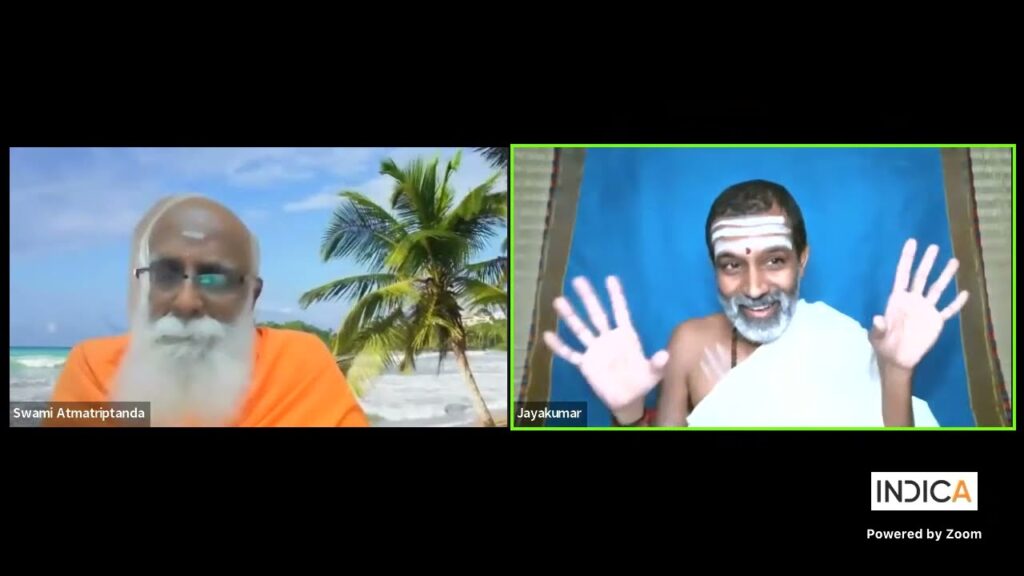
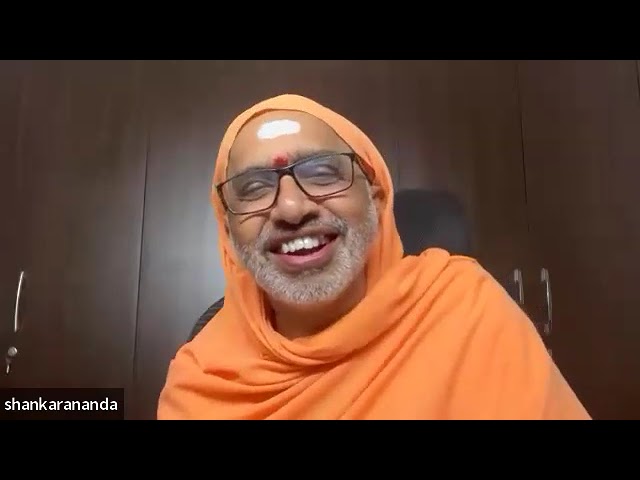
Arsha Seva Kendram celebrated this year’s Bhagavad Gita Jayanti on November 30 and December 1, 2025. On November 30, the students of the Kendram were blessed to receive an Anugraha Bhashanam from Swami Shankarananda Saraswati of Arsha Vidhya Gurukulam. On December 1, the students chanted the verses from the Bhagavad Gita. We present here a summary of Swamiji’s inspiring talk.
Search for Ultimate truth and freedom
The Upanishads and the Bhagavad Gita are dialogues, but in the Gita, the exchange between Krishna and Arjuna feels more relatable to today’s human being. Arjuna, as a kshatriya, is bound to fight against adharma, yet he resists his duty and considers renouncing action through Sanyasa. His struggle mirrors our own tendency to avoid what we dislike and cling to what we prefer, driven by raga-dwesha (likes and dislikes). However, unlike us, Arjuna faces the painful dilemma of fighting revered figures such as his Guru and grandfather. Seeing Krishna as the all-knowing guide, Arjuna turns to Him for clarity on what is truly right: whether to follow the path of Preyas, doing karma or the path of Shreyas, absolute freedom where nothing remains to be accomplished, the state beyond all duties and attainments.
व्यामिश्रेणेव वाक्येन बुद्धिं मोहयसीव मे ।
तदेकं वद निश्चित्य येन श्रेयोऽहमाप्नुयाम् ॥3.2
Karma Yoga
Karma is every action we perform, rooted in the freedom to choose. It is kartrutantram – dependent on the doer or agent, and therefore never-ending. Escaping karma is not possible; instead, one should engage in karma yoga, focusing on the action itself without identifying with the results. Human action is only one of hundreds of factors influencing even a single outcome. Since outcomes are beyond our control, they must be surrendered to Bhagavan.
कर्मण्येवाधिकारस्ते मा फलेषु कदाचन |
मा कर्मफलहेतुर्भूर्मा ते सङ्गोऽस्त्वकर्मणि ||2.47
Bhakta and Bhagavan
The four types of Bhaktas are those who seek Bhagavan in distress (Artha Bhakta), for fulfilling desires (Arthaarthi Bhakta), for knowledge (Jignaasu Bhakta), or with true wisdom (Gnani Bhakta). Bhagavan is unborn, eternal, unchanging, and the ordainer of all, manifesting creation while remaining untouched by it.
अजोऽपि सन्नव्ययात्मा भूतानामीश्वरोऽपि सन् ।
प्रकृतिं स्वामधिष्ठाय सम्भवाम्यात्ममायया ॥4.6॥
He is nitya (beyond time), sarvagata (all-pervading), avyaya (unchanging), and sanatana (ever existing). The Gnani Bhakta (wise person) realizes Bhagavan not through imagination but by recognizing Him as the indwelling witness in the heart and intellect—the one who watches every thought arise and pass away.
ईश्वरः सर्वभूतानां हृद्देशेऽर्जुन तिष्ठति ।
भ्रामयन्सर्वभूतानि यन्त्रारूढानि मायया ॥18.61॥
He is the cause of whatever occurs in vyavahaara as karma-phala-daata (the giver of the fruits of action) yet remains untouched by everything—avyaya. Surrendering with this clarity brings complete freedom, total peace, even when the mind is disturbed. It is eternal (sthanam)- that in which you are. You cannot be away from it. (shasvatam).
Uniqueness of the Bhagavad Gita
The Bhagavad Gita is not only a Moksha Shastra but also a Yoga Shastra, teaching us to perform our duty without being swayed by raga and dveṣa. In this way, it offers guidance for both absolute liberation and relative fulfillment, setting itself apart from other scriptures.