Dharma Vidya
Overview
Children today grow up amidst unprecedented academic demands, social pressures, digital exposure, and questions of identity and belonging. Many parents and educators find it increasingly challenging to nurture emotional balance, ethical clarity, cultural rootedness, and inner confidence in such an environment.
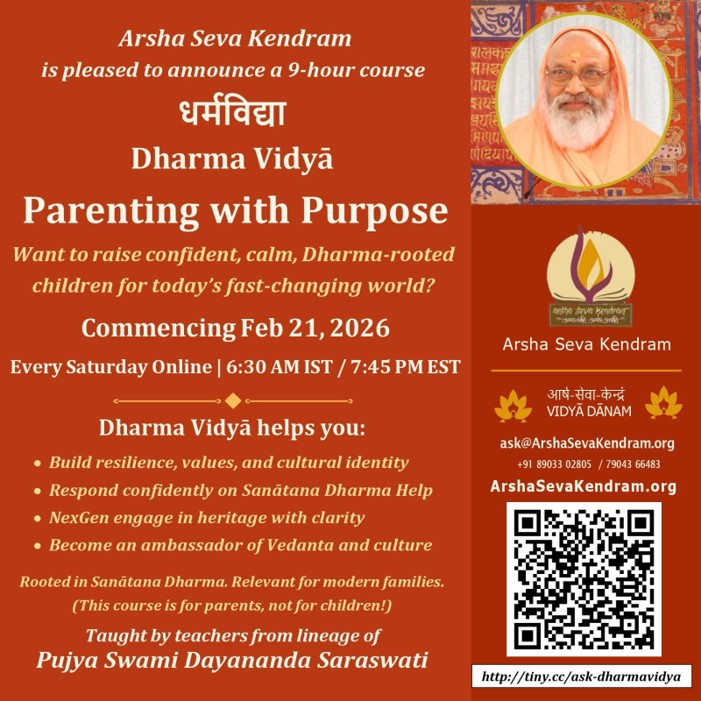
Dharma-Vidya is designed to support parents and educators by introducing the foundational principles of Sanātana Dharma in a thoughtful, structured, and practical manner. The course explores enduring Dhārmic values as they emerge from India’s classical texts and living traditions, and demonstrates how these insights can be meaningfully applied in contemporary family life.
The course emphasizes reflection, discernment, compassion, responsibility, and self-understanding—vision & values that hold universal relevance. Participants will also be guided on how to communicate these ideas to children and adolescents in age-appropriate ways, fostering resilience, self-worth, ethical clarity, and cultural confidence.
Course Objective
By the end of Module 1, participants will be able to:
- Develop a clear and grounded understanding of Hindu Dharma as a way of life, and be inspired to learn more
- Support a child’s emotional and spiritual growth in a rapidly changing world
- Respond thoughtfully and confidently to common questions on Sanātana Dharma
- Foster inner strength, resilience, and self-esteem in children
- Offer value-based education rooted in India’s philosophical and cultural heritage
- Encourage cultural confidence alongside openness and discernment
- Help the next generation engage with their heritage with clarity rather than conflict
- Address contemporary challenges such as bullying, substance abuse, excessive social-media exposure, and peer pressure through Dhārmic perspectives
- Appreciate India’s civilizational history with nuance, depth, and authenticity
Topics Covered
Module 1
- Introduction
- What are we seeking in Life (Purushaarthas)
- Vedas
- Value of Values
- Significance of Prayer
- Classic shlokas, meanings
- Unique Aspects – Ishwara, Devata, Ishta Devata, Karma, Avatara, Samskaras, Murti Puja, Chanting
- Introduction to & Practice of Puja
- Meaning of Om
- Answers to typical questions (‘Do we have one God or many Gods?’)
- Whitewashed history and pride in real history of India
- Modern challenges like bullying, shaming, drugs, conversion
- How to teach dharma to children or youth
Upcoming modules
- Dharma in Mahabharata
- Value of Values
- Ishwara & Religious Disciplines
- Religious Culture
- Sanatana Dharma
- Human Development and Spiritual Growth
- Vedic Knowledge
- Introduction to Bhagavad Gita
- Puja & Prayers
- Answers to kids’ questions (why are there so many Gods? Why do we pray to a murti? And so on)
At the end of Module 1 students are expected to know the following:
- Understand the basic concepts of Dharma and Purushaarthas.
- Learn the significance of Vedas and key Shlokas with meanings.
- Grasp the roles of Ishwara, Devata, Ishta Devata, Karma & Samskaras.
To Register: Click here
- Know the practice and purpose of Puja and its essentials and the meaning of concepts like “Om” .
- Get answers to common philosophical questions about gods & spirituality.
- Recognise the difference between whitewashed history and authentic Indian heritage.
- Identify modern challenges (bullying, shaming, drugs) and their ethical handling.
- Acquire methods to teach Dharma effectively to children & youth.
- Develop personal refl ection on values and prayer in daily life.
- Prepare for further modules with a solid philosophical foundation.